The traditional Japanese art of haiku, which as we know it is quite modified from its original structure due to European appropriation, has several inherent links to the world of the digital. Both involve one creating something meaningful within limitations (whether that entails the fixed syllable structure in the former or the specific syntax of code in the latter), and this may provide a reason for why Stephanie Barber chose this form of poetry for Status Update — her Facebook experiment turned book. Reading this text allowed me to confront the interrelationship between art and social media, and how they both generally involve one expressing personal ideas in an engaging format, as well as the limitations imposed by one’s choice of form when expressing oneself. In particular, people expect haiku to have a rigid, predictable format, leading me to wonder how an artist can express themselves while staying true to this precise form, as well as how can an artist play with expectations by slightly modifying this form while still staying recognizable as a haiku.
Mad Lib Haiku
To that end, I first looked toward a Mad Lib Haiku generator, which acts exactly as one would suspect. After entering various nouns and adjectives, I generated the following three nonsensical “haiku”:
In the red pencil
these funny mouse
A great clock

In the historical banana
these terrible book
A noteworthy flower

In the difficult time
these outstanding computer
A nonchalant poem
One important factor to notice is that none strictly follow the 5-7-5 syllable pattern most associate with the poem form (although the last is only off by one syllable, I assume that to be more of a coincidence than any indication of correct computer programming). Even more striking, however, is that all three poems conform to the same exact structure:
In the (adjective) (noun)
these (adjective) (noun)
A (adjective) (noun)
This indicates that the term “mad lib” was taken literally, and the program merely inserts one’s chosen words into a predetermined form, which, in a clear manner, makes this program even more restrictive than a normal haiku, but in another manner, and maybe not so obviously, allows for more freedom. Specifically, the program does not check to make sure the words have the correct number of syllables, allowing for a wider variety for choice of words, and the program does not care if the poems make any logical or grammatical sense (the second line in all my poems disagree with the choice of determiner (“these terrible book”)). Moreover, testing the program more shows that it does not recognize if an adjective is actually placed in the correct box, and same for the nouns, so one can generate a haiku containing random characters and words:
In the asdkf hello
these sldnkd23456 yes
A bniuiweoi 1234567890
If I were to take that preceding “haiku” and tell someone I personally wrote it, they would likely think it was a weird joke. Knowing that a computer generated it, though, justifies its meaninglessness. Specifically, people currently do not expect computers to have the capabilities to make any artistic judgments, and programming a true haiku generator would take a substantial amount of processing power and coding expertise, so they cannot know any better when somebody asks them to output a nonsensical string of text. Thus, while the structure of this generator may be more rigid than a traditional haiku, it allows for wider modes of expression, but it does not contain any preconceived notions of good art.
Social Media Haiku
Using another haiku generator on the same website, that attempts to process a string of text into poems, yields some unusual results. I took a few tweets written seven years ago (which I will not replicate here, because they are, for lack of a better term, cringy high-school tweets), and generated the following four haiku:
The
a his so
so.

From been to new
The had had have
To the new.I.

The t
lately his a
.

a's to
hear of the t!
the t's able through
Again, note that none of the haiku even get close to following the 5-7-5 syllable pattern, but this time, they at least do not seem to all fall into one rigid structure like the mad lib haiku. These poems, somewhat reminiscent of something e.e. cummings would have written, are striking in their opaqueness, as well as their unusual choice of punctuation. My tweets were fairly simple sentences, and I am curious as to how the computer morphed them into these incoherent texts. I am particularly interested with the third haiku, and how its third line is simply a period: “.”, possibly indicating complete silence after the “t.”
I asked Nelson Sing to choose one of the haiku and write a potential illustration, and he chose the second and wrote the following: “The Elysium gardens, the ‘new’ I which makes me think of some sort of new world, the been to new like a transition from a dead winter garden to a spring flower garden.” I appreciated his earnestness in creating this picture, because it made me reconsider the poem as something that could be evocative. What I initially took as an incoherent string of nonsensical text was given value and some meaning by Nelson’s perspective, and it made me reflect on how every individual can look at the same poem with a unique perspective. Similarly, in Stephanie Barber’s Status Update, there were several instances when my initial reading of the poem was rather superficial, and the accompanying illustration made me rethink the haiku’s value. For example, on July 21, 2010, Barber wrote:
seat 31 e
regales one with an array
of varied bald spots
and Lauren Bender’s illustration is simply the word “dad” (202). This simple response made me look back to the poem and consider what could remind one of one’s father. There’s the superficial possibility that the phrase “bald spots” recalls to mind the typical male-pattern baldness many fathers undergo, but I also wonder if there is some other paternal element of the poem. Regardless, this example, as well as Nelson’s illustration, demonstrates the ability of poetry, even if computer-generated, to elicit a personal emotional response.
The Imagery of Haiku
The third tool utilized was a text-to-image generator which attempts to output an image relevant to what one writes. I started by writing a haiku in the program, which led to the following result (the haiku is in the caption):
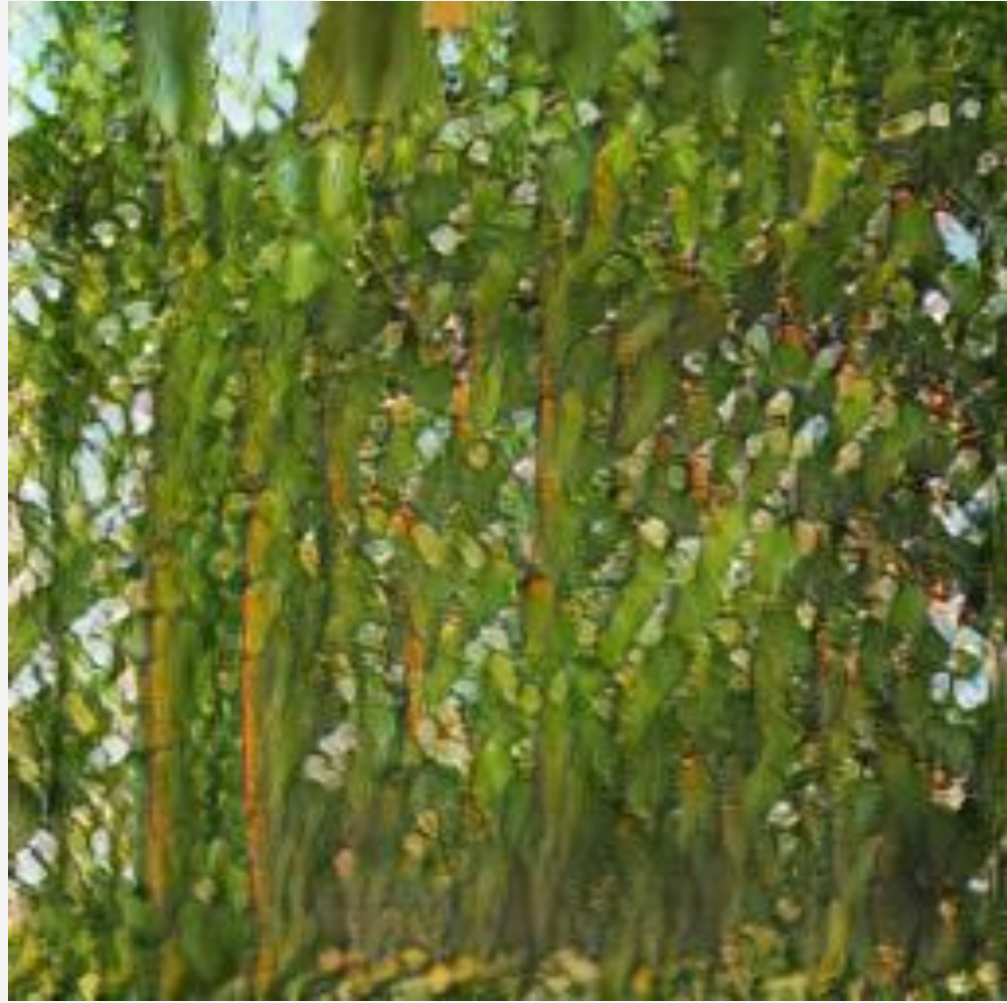
An aspen tree stands behind.
It’s not always so.
I am impressed that the image generated resembles a Japanese watercolor painting of a garden (even if it is green and not red). While it may be a coincidence, I think the image complements the text. For comparison, I expanded the haiku into a longer prose passage and generated the following image:
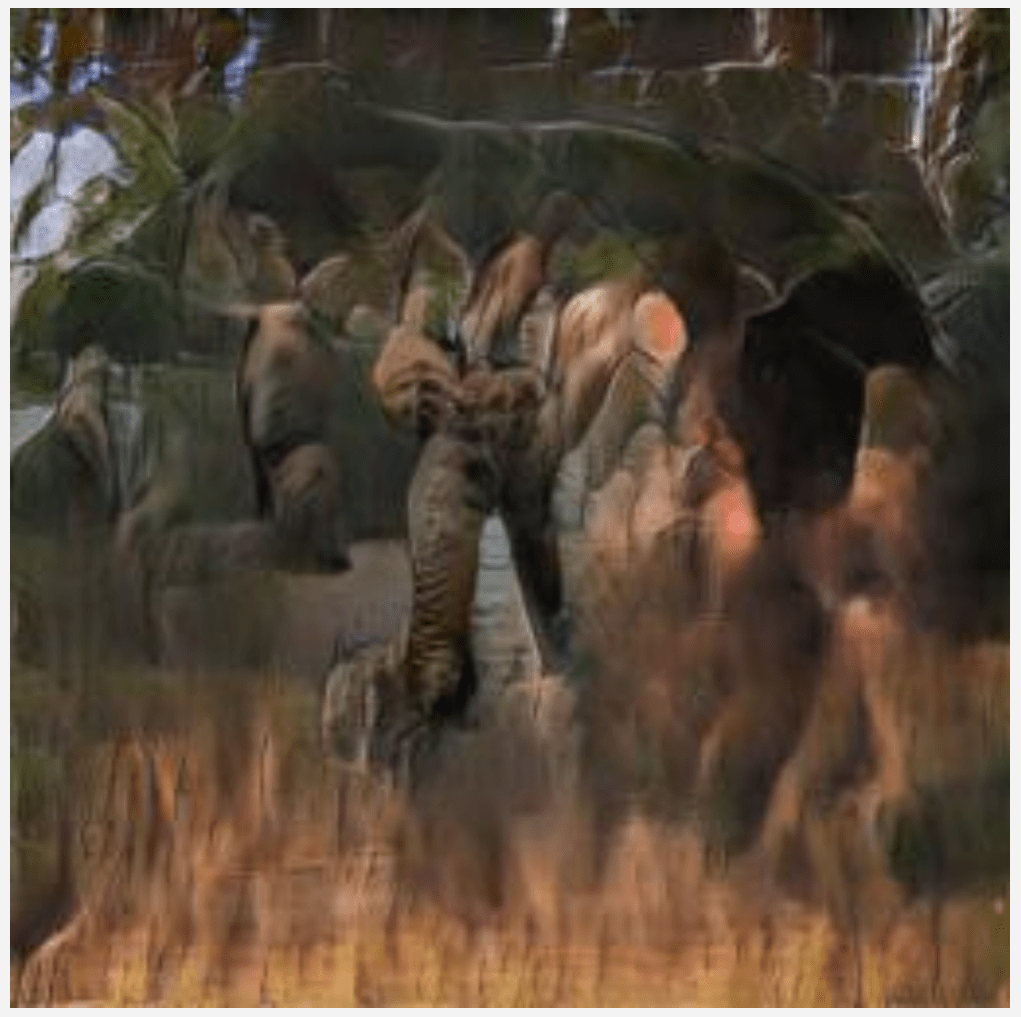
Again, I appreciated the image’s relevance to the passage, and I perceive what appears to be a tree falling and a barren garden. In this sense, the first image demonstrates the garden initially, while the second resembles a passage of time. While I may be reading too much into these images, they demonstrate artistic merit, even if they were not created by a human artist. Out of curiosity, I also generated an image for an English translation of a poem written by the famous Basho:
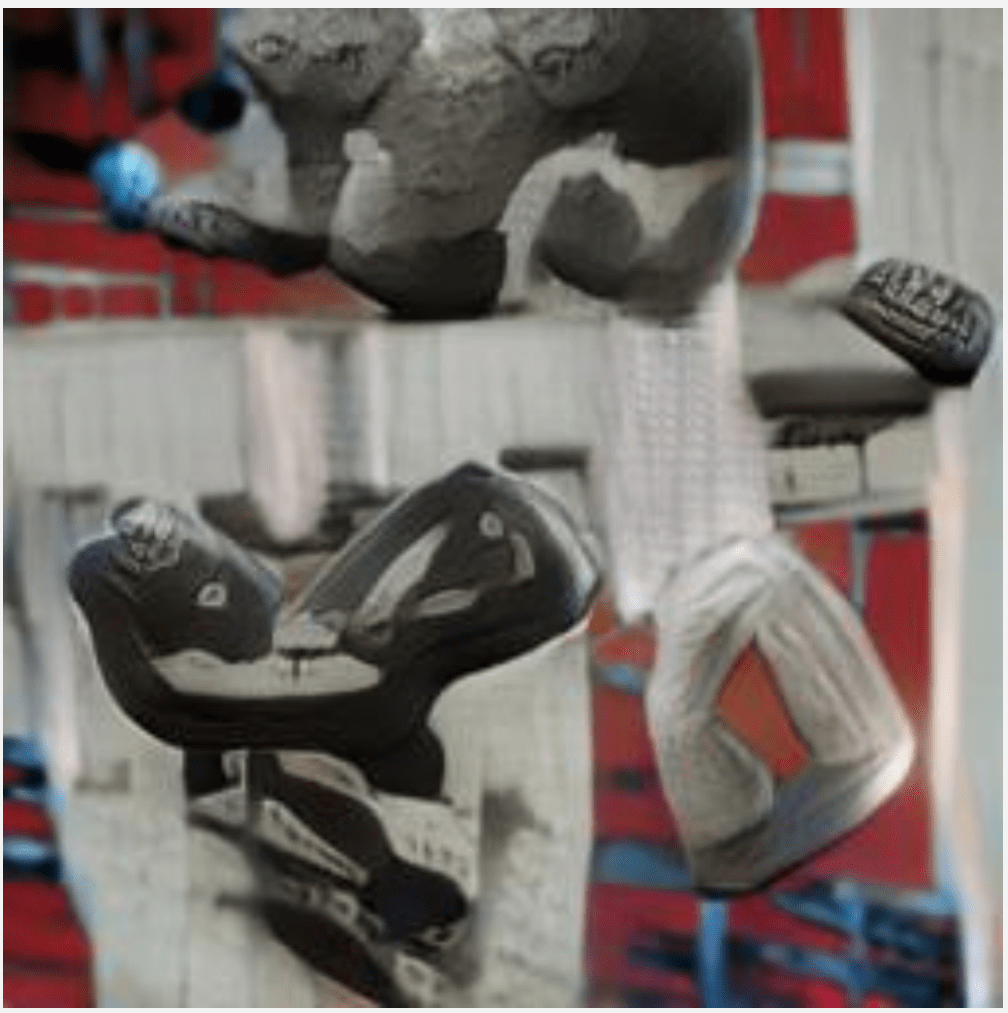
A frog leaps in.
Splash!
In this instance, the image seems to stand in stark contrast to the imagery generated by the poem. I have a difficult time seeing anything reminiscent of a pond, a frog, or the sound of water, but I may just not be looking at it from the correct perspective. Finally, to obtain a better understanding of the image-generating program, I took a ten-page essay I wrote last semester about Walden by Henry David Thoreau, and received this image:
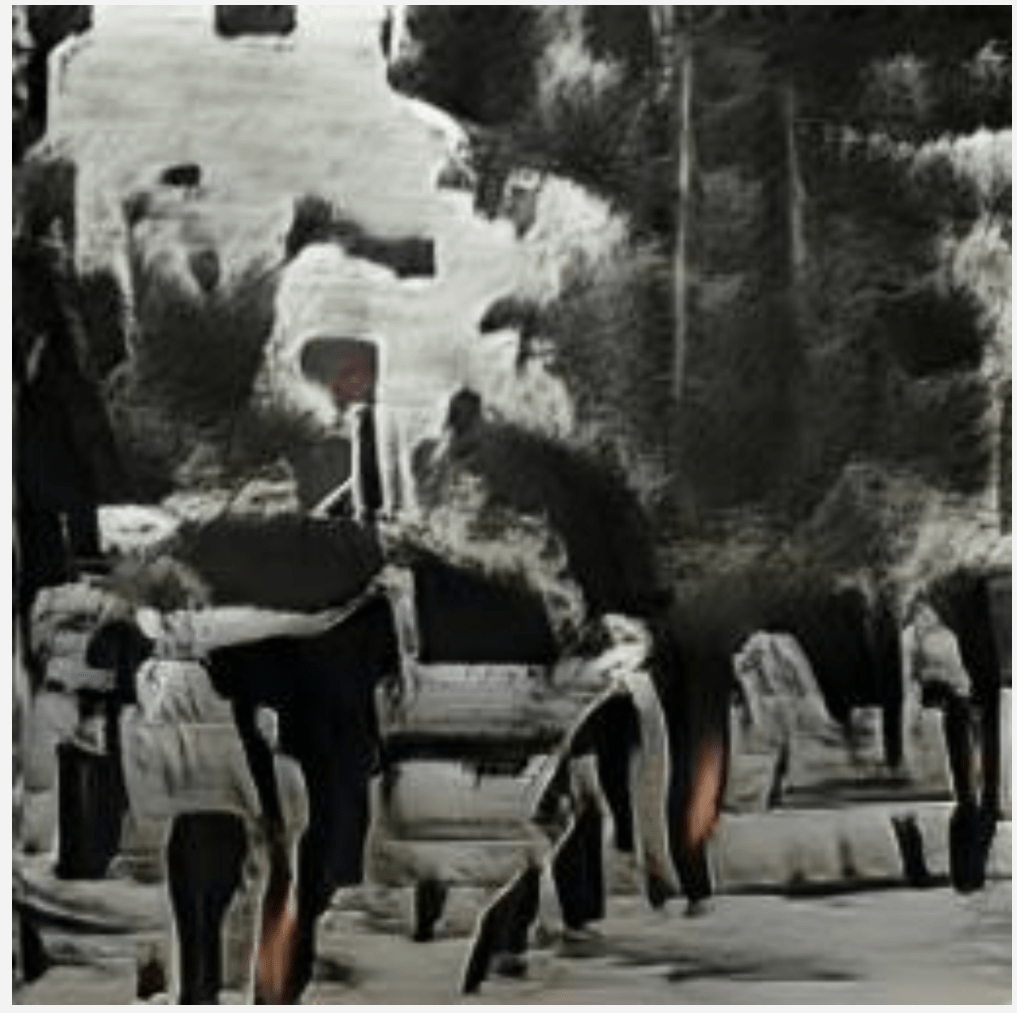
I am interested in the image’s sparse color, which could relate to the more academic style of writing which foregoes detailed imagery, or it could be related to the specific language I used in my essay. I see some elements similar to wildlife and water in the image, which relate to the text, and the image leaves itself open to interpretation. The images also remind me of the potential contrast set up between Stephanie Barber’s poems and Lauren Bender’s illustrations, where the latter can diverge from my own expectations set up by the former. For example, on February 20, 2010, Barber’s poem reads:
that silver of moon
is a thrushes' warbling song
all silvery highs
while Bender’s illustration reads “my new alarm clock or a night-bird but we know better” (51). Personally, this poem brought to mind images of nature and a forested environment at night, while Bender appears to focus more on the song and relates it to an alarm clock. The divergence in interpretation indicates the social nature of poetry, and how more value can be gained by individuals sharing their perspectives. Moreover, as this tool indicates, computers themselves can enter into the discussion, even if their images are nearly indecipherable. Regardless of any deeper meaning, however, this experimental tool showed me the variety of imagery that can be generated by computer programs. In effect, computers already can demonstrate interpretive powers that allow humans to reflect on their own experiences.
Relevance to Status Update
Ultimately, the tools utilized in this lab have demonstrated the potential relationship that can exist between poetry and computer software. Whether the poems are being created by the computer itself, based on human input, as in the first two tools, or the computer is used as a tool to examine and express human-created content, as in the third tool and Barber’s work, a relationship between human user and computer system develops, where each allows the other to express themselves more fully. I am beginning to understand N. Katherine Hayles’ concept of “intermediation” as a framework for understanding the ways in which humans and machines form a symbiotic bond in the pursuit of expressing diverse perspectives. Moreover, Barber’s haiku, and Bender’s illustrations, showcase not only the interpretive dialogue that art inspires, but the ability of computer software to facilitate that dialogue through social media tools. While comments on websites like Facebook, Twitter, and YouTube have an unfortunate reputation for insipid or hurtful, they have the potential to express complex emotional beliefs that thoughtfully respond to the content posted.
 Another Digital Humanities Blog