As I alluded to toward the end of the previous lab, I consider all writing to be political, regardless of subject matter or authorial intent. To summarize what I described there, I believe that any form of communication contains inherent biases, which we should recognize and not take for granted. While one’s words may seem harmless now, future retrospection will only exacerbate its potential flaws. I believe that this is nowhere more apparent than in the corporate apology. Often texts like these attempt to dispel controversy, but due to their unapologetic rhetoric and ambiguous phrasings, many quickly find fault with these messages, only leading to greater political strife. As an example, consider Blizzard Entertainment‘s response to its decision last October to ban a player named Blitzchung from competing in their tournaments after he made a comment in support of the Hong Kong protests that were then (and still are) raging. The company’s response (the text of which will form the basis of this lab) was criticized for merely apologizing for “acting too quickly,” and many felt that their financial relationships with China directly impacted their decision to not completely rescind their ban. While I understand that the protests occurring in Hong Kong derive from complex social, historical, and political debates, and I am by no means an expert on the subject, I still found Blizzard’s conduct to be overbearing and extremely reactionary, for what was a brief comment. I understand why they would not want players to spout political messages during their events, but I feel that their punishment and subsequent “apology” were rather draconian, and I was curious how data-mining tools could give concrete evidence of the political evasion latent within their rhetoric.
Tools and Data:
Before describing my results, I should explain the tool I used and how it displayed my results. I utilized Voyant, a digital data-mining tool much more powerful than Textalyser, and the results can be seen in the image below:
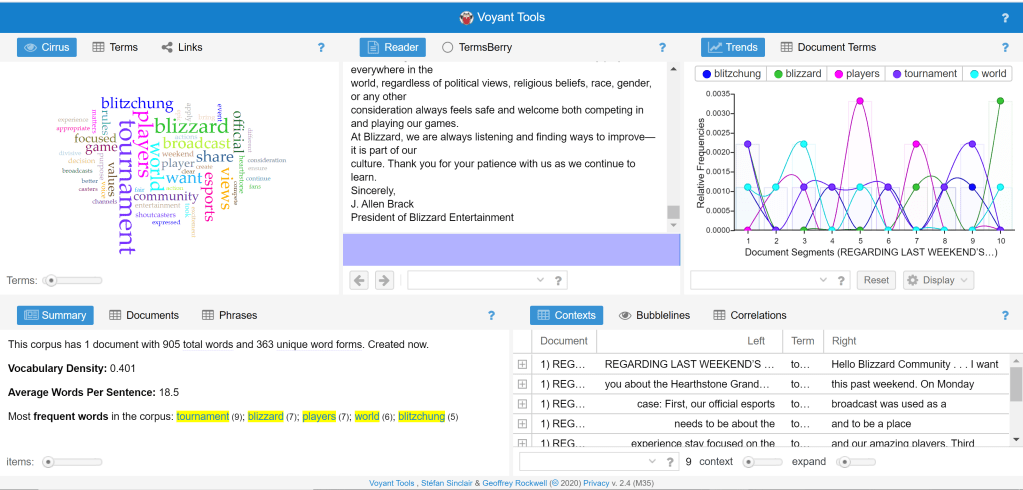
I was a fan of this tool’s mix of visual and textual data, as it not only presented useful information, but it did so in an easy to understand format. While the initial page was a little overwhelming, it quickly became understandable, and I was able to preview most of the data effectively. The “Cirrus” text-visualization in the top-left concisely expressed the most commonly used words, giving a quick overview of the main results, and the “Reader” in the top-center provides a handy tool to search for specific words and determine their frequencies. These modules combine to allow one to select a word and see all the places it appears throughout the text. Finally, the block in the top-right was easily modifiable, and it provided a variety of different text-visualization methods, the current one being “Trends,” which displays the frequencies of different terms in different segments of the text. While I did not fully understand the data being presented in many of the text-visualization methods, such as “TextualArc” and “Mandala,” they were all interesting to look at and provided for unique interpretations of the text.
Specific Results:
Now looking at the specific results of the data-mining, I first observed that the most commonly utilized word was “tournament,” the second was “Blizzard,” and the third was “players,” while the phrase “Hong Kong” only appears twice, and the word “China” only once. This fact immediately shows that the apology was more focused on the company and its event and players rather than on the controversy and its potential impacts. One of the author’s main points is that the company wanted Blitzchung’s interview to focus on the game itself and not on any political situations outside the event, and the text correspondingly accomplishes this by focusing more on the tournament than on the political impacts of its decisions. Moreover, the political term “world” mostly appears at the beginning of the text, while the words “tournament” and “players” are much more evenly spaced. This indicates that while the company addressed the potential implications of Blitzchung’s statements at the beginning of the text, it was constantly more focused on its own tournament and the impacts of Blitzchung on the other players. Moreover, the company’s name appears mostly toward the end of the text, so that the text ends with a self-centered exploration of its own values and viewpoints. In effect, the text addresses the political statements only as much as it needs to, and then attempts to enforce Blizzard’s will and justify its actions. The article frequently utilizes plural first-person pronouns (“we” 29 times and “our” 23 times) to enforce its authority, while also obscuring the notion of a singular author (it only uses the word “I” three times, despite supposedly being written by one person). Thus, the text demonstrates the faceless corporate aspect of Blizzard’s decision which was primarily focused on financial implications and ignored any concerns regarding human rights. It lacked humanity in the face of inhumanity.
Poetic Experimentation:
To complete this lab, I took Blizzard’s “apology,” cut it apart, and created my own poetic work in an attempt to provide personality to a faceless text:
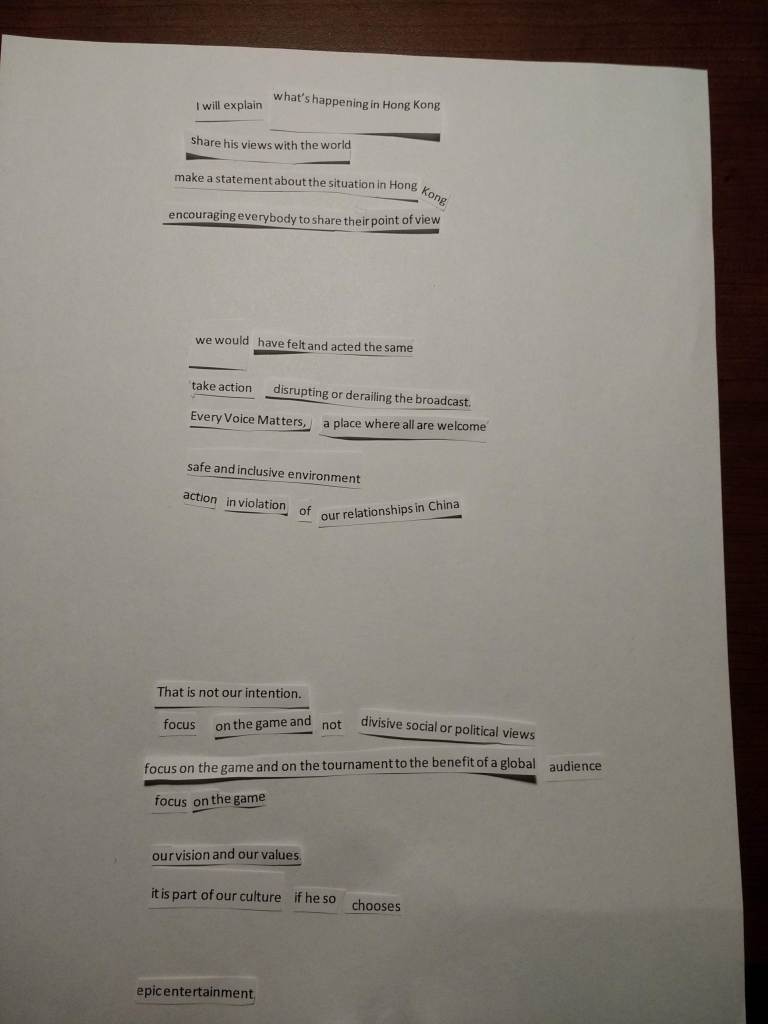
When creating my poem, I applied the data collected by starting off with questions and statements about Hong Kong, and with a hopefulness of people being able to share their opinions without fear of censorship. I allude to a place that Blizzard describes as “safe and inclusive” and where “Every Voice Matters,” but which their actions did not help to create. However, just like the article, I contrast this perspective by ending with an exploration of the greedy corporation which only wishes consumers to think about its products and ignore any potential impacts on the political reality. The article contained three variations of the phrase “focus on the game,” and I wished to include these to highlight the myopic dystopia that the article implies. I end the piece with the phrase “epic entertainment”: a stock and meaningless phrase that summarizes Blizzard’s entire rhetoric. Effectively, my poem demonstrates the transition from political optimism, where we could create a place to explore different ideas and perspectives, to political antipathy, where any mention of “social or political” issues contradicts a corporate ideology. I am trying to return a voice to the silenced.
 Another Digital Humanities Blog